Why Replacing an Industrial Sensor Is Not Always the Best Solution
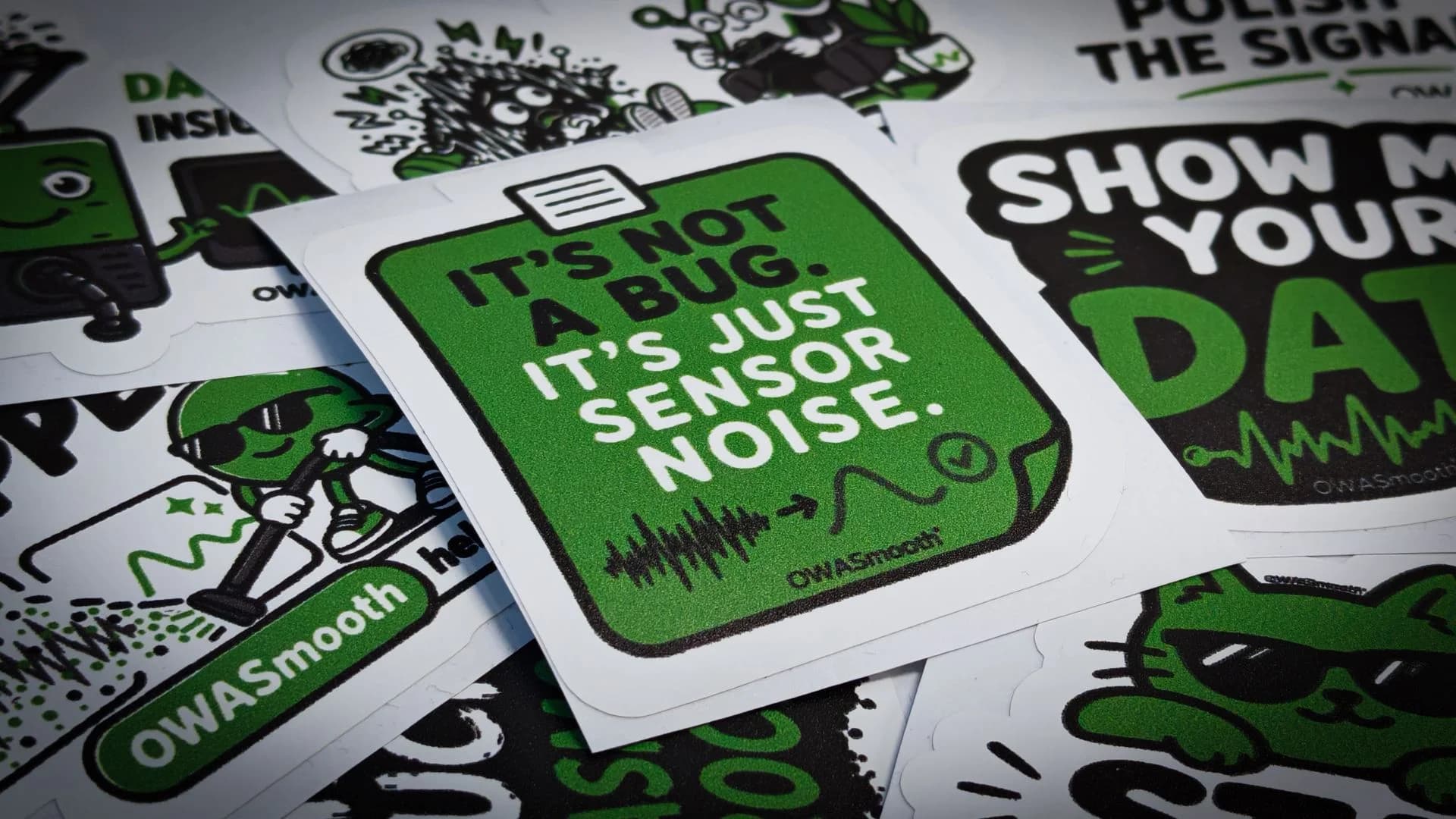
“Let’s replace the sensor.”
When measurement data becomes unstable or unreliable, this is often one of the first proposed solutions.
And sometimes, it is the right one.
Sensors get damaged. They age, lose calibration or turn out to be unsuitable for the required measurement range, accuracy or operating environment. No amount of data processing can repair hardware that is fundamentally unable to produce meaningful measurements.
But sometimes, the sensor is not really the problem.
It is simply the first thing we blame.
Before investing in new sensing equipment, it may therefore be worth asking a different question:
Can we improve the measurements we already have?
A new sensor does not remove the environment around it
Industrial sensors operate in real environments, not in controlled laboratory conditions.
They work close to motors, machines, power electronics, moving components and changing environmental conditions. Their measurements can be affected by:
- mechanical vibrations,
- electromagnetic interference,
- sudden temperature changes,
- sensor ageing or calibration drift,
- process-specific disturbances,
- isolated outliers and short-term fluctuations.
A more expensive sensor may provide better accuracy, resolution or stability, but it will still operate in the same environment.
It may still record vibrations.
It may still experience transmission errors.
And it may still produce an occasional value that clearly does not belong there, usually at the least convenient moment.
This does not mean that sensor quality is unimportant. It means that replacing the sensor and improving the data are two different things, and we should understand which one we actually need.
What does “poor-quality data” really mean?
The phrase sounds straightforward, but it can describe several very different problems.
Measurement data may be affected by:
- random noise superimposed on the underlying signal,
- isolated outliers,
- missing or duplicated measurements,
- systematic measurement bias,
- unexpected or inaccurately recorded sampling intervals,
- an insufficient sampling rate,
- sensor saturation or clipping,
- real process fluctuations that only appear to be noise.
These problems should not be treated in the same way.
Missing values require a different approach from random noise. Data processing can reduce noise and other unwanted disturbances, but it cannot reliably recover information that the sensor did not capture in the first place. For example, if a signal exceeds the sensor’s measurement range or changes too quickly for the selected sampling rate, some information may already be lost before the processing begins.
And a sudden spike may be a measurement error, but it may also be the first indication of an actual process anomaly.
This is why the first step should not be choosing a filter.
It should be understanding how the data was generated, what may have affected it and which information must be preserved.
Why sensor replacement may not solve the problem
A higher-quality sensor can certainly improve measurement performance. Replacement may be necessary when the existing sensor is damaged, incorrectly selected, poorly calibrated or unable to meet the technical requirements of the application.
However, if the main source of the problem lies in the environment, transmission or subsequent processing, a new sensor may remain exposed to many of the same conditions.
The company may then invest in new hardware and continue to encounter fluctuations, outliers or unreliable outputs.
Replacing industrial sensors can also introduce additional costs related to:
- procurement,
- installation,
- calibration,
- production downtime,
- system integration,
- testing,
- adjustments to the existing software or control system.
For systems containing tens or hundreds of sensors, these costs can quickly become significant.
Testing whether the current measurements can be improved through better processing is often a much smaller first step.
Start by understanding the data problem
Before deciding on a hardware upgrade, we should examine how the problem actually behaves.
A few practical questions can help:
- Is the signal continuously inaccurate, or does the problem occur only occasionally?
- Are the errors random, periodic or connected to particular operating conditions?
- Does the signal contain isolated outliers or longer periods of instability?
- Is the likely source of the problem the sensor, its environment, data transmission or subsequent processing?
- Which events or signal characteristics must not be removed?
- How does poor-quality data affect the final technical or operational decision?
- What measurable improvement would create meaningful value?
The last two questions are particularly important.
A signal is rarely processed simply because someone wants a nicer graph. It is processed because a person, control system or analytical model needs to make a decision based on it.
That decision should determine what “better data” actually means.
A smoother signal is not automatically a better signal
It is relatively easy to make a signal look smooth.
Increase the filter window, suppress large deviations and remove anything that does not follow the general trend. The resulting curve may look much cleaner.
But it may also be less useful.
Every smoothing method changes the data in some way. It can introduce delay, flatten peaks, remove short events or distort meaningful transitions. A method that works well for slowly changing temperature measurements may be completely unsuitable for torque data, vibration monitoring or anomaly detection.
There is no universally best filter.
There is only a method that is appropriate, or inappropriate, for a particular signal and purpose.
For us, this is one of the most important principles of data processing:
The goal is not to create the smoothest possible curve. The goal is to remove what is unwanted while preserving what matters.
And that second part is usually much harder.
When data processing can help
Data processing can be particularly valuable when the sensor captures the essential behaviour of the system but the signal also contains noise, fluctuations or occasional outliers.
A suitable method may improve the stability and usability of the measurements without changing the existing sensing infrastructure. Depending on the application, this can support more reliable:
- process monitoring,
- anomaly detection,
- predictive maintenance,
- robotic control,
- energy management,
- quality inspection.
However, the method should be evaluated according to the needs of the actual process, not only according to how the output looks.
If the objective is to display a stable long-term trend, a small delay may be acceptable. If the data controls a moving robotic component, even a short delay may matter. If the task is anomaly detection, removing unusual values too aggressively may remove exactly the events we need to identify.
A visually cleaner signal can be a good sign, but it is not enough.
Depending on the use case, we may also need to evaluate noise reduction, error against a reference, preservation of peaks, signal delay, computational requirements or the effect on the final decision.
Sometimes, the most valuable result is not a prettier curve.
It is a more stable control response, fewer false alarms or a decision that can be made with greater confidence.
How OWASmooth approaches the problem
At OWASmooth, we work with numerical data from sensors, industrial processes and other measurement systems.
Our approach is deterministic, explainable and designed with computational efficiency in mind. The objective is to reduce unwanted disturbances while preserving the signal characteristics that matter for the specific application.
But we do not begin by assuming that one method will work for every signal.
We begin with the data, the operating conditions and the decision that depends on the measurements.
We examine what is considered noise, which events must be preserved, how the result should be evaluated and where the processing needs to run. A solution intended for a microcontroller or edge device must meet different computational and latency requirements from an offline analysis.
Because the best-looking output is not necessarily the best-performing one.
And because sometimes the technically correct conclusion really is: replace the sensor.
We are fine with that too.
Before replacing a sensor
Before replacing a sensor, it is useful to assess three areas separately:
The sensor: Is it functioning correctly, properly calibrated and technically suitable for the measurement?
The operating environment: Are vibrations, interference, temperature changes or process conditions affecting the signal?
The data processing: Can unwanted disturbances be reduced while preserving the information required by the application?
In practice, the most effective solution may involve improvements across all three areas.
The important thing is not to treat sensor replacement as the automatic first response, or data processing as a magical solution to every measurement problem.
Both have their place.
The real task is to understand where the problem begins and what kind of improvement would genuinely matter.
So, before replacing the sensor, take a closer look at the data.
The existing measurements may already contain the information you need. The real question is whether it can be extracted more reliably.
Are unreliable measurements affecting your process? Contact OWASmooth to explore whether your existing data can be improved before you invest in new sensing hardware.